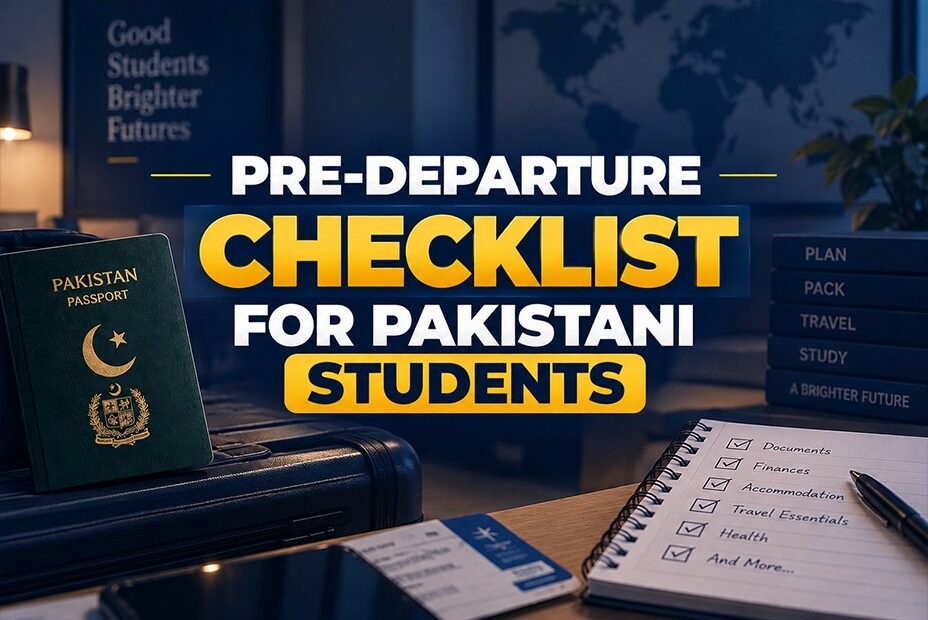
Pre-departure checklist for Pakistani students covering documents, packing, finances, accommodation, travel, and essential preparations before your flight.
Your Ticket Is Booked. Now What?
Getting your university admission and student visa can feel like the hardest part of your study abroad journey from Pakistan. But once your visa is approved and your flight is booked, there is still plenty to organize.
Moving to another country for education is exciting, but arriving prepared can make your first few weeks much easier.
From important documents and finances to luggage and accommodation, this pre-departure checklist for Pakistani students covers the essential things you should complete before boarding your flight.
1. Organize All Your Important Documents
Your documents are among the most important things you will carry with you.
Create a physical folder and a secure digital backup containing:
– Passport
– Student visa
– University admission letter
– Enrollment documents
– Academic certificates and transcripts
– Scholarship documents, if applicable
– Accommodation confirmation
– Travel and health insurance documents
– Flight ticket
– Emergency contact details
– Passport-size photographs
Keep your original documents in your hand luggage rather than your checked baggage.
Pro tip: Save scanned copies in a secure cloud account and keep another copy on your phone or laptop.
2. Confirm Your University Details
Before leaving Pakistan, make sure you know exactly where you are going.
Save your:
– University address
– Campus location
– Orientation date
– Enrollment deadline
– International student office details
– University contact number
– Student accommodation information
Check your university email regularly for any last-minute instructions.
3. Finalize Your Accommodation
Don’t leave your accommodation arrangements until you arrive.
If you have university accommodation, confirm your booking and check the move-in date and arrival instructions.
If you are staying in private accommodation, make sure you have the complete address, contact details, contract, and instructions for collecting your keys.
Having a confirmed place to stay can make your arrival much less stressful.
4. Plan Your Finances
Money management is an important part of preparing to study abroad from Pakistan.
Before your departure, understand how you will manage your expenses.
Prepare for:
– Accommodation payments
– Tuition fees
– Food
– Transportation
– Mobile phone expenses
– Study materials
– Emergency expenses
Carry some local currency for your destination so you have access to money immediately after landing.
Also check with your bank about international transactions, card usage, and applicable charges.
5. Check Your Luggage Carefully
Packing for an international move is different from packing for a holiday.
Make a list before you start packing.
Essentials to consider:
– Suitable clothes for the destination’s climate
– Comfortable shoes
– Basic toiletries
– Medicines or personal essentials, where permitted
– Laptop and chargers
– Phone and charging accessories
– Universal travel adapter
– Important stationery
– A few familiar items from home
Check your airline’s baggage allowance before packing. Avoid carrying prohibited items or unnecessary things that will add weight to your luggage.
6. Prepare for the Weather
Don’t assume the weather will be similar to Pakistan.
Research the climate of your destination and the season when you will arrive.
If you’re travelling to a colder country, you may need suitable winter clothing. If you’re going somewhere warm, lightweight clothing may be more appropriate.
You don’t necessarily need to pack an entire wardrobe. You can purchase additional items after arriving if necessary.
7. Get Your Phone and Connectivity Ready
Staying connected is important when you first arrive.
Before leaving Pakistan:
– Check whether your phone is compatible with your destination’s networks.
– Research local SIM or eSIM options.
– Save important contacts.
– Download maps for your destination.
– Keep your university’s contact information accessible offline.
Having reliable communication can be especially useful during your first few days.
8. Learn the Basics of Your Destination
You don’t need to become an expert before your flight, but knowing the basics can make your transition easier.
Research:
– Local transportation
– Currency
– Emergency services
– University surroundings
– Grocery stores
– Banks
– Public transport
– Local customs
– Basic phrases in the local language
Even learning a few everyday phrases can help you feel more comfortable in a new environment.
9. Arrange Your Airport Transfer
One of the easiest things to overlook is how you will travel from the airport to your accommodation.
Before your flight, confirm:
– Airport name and terminal
– Arrival time
– Transportation options
– University shuttle, if available
– Taxi or ride-hailing options
– Accommodation address
Keep the address saved on your phone and written somewhere in your hand luggage in case your phone battery runs out.
10. Prepare for Your First Week
Don’t focus only on the flight. Think about what happens after you land.
Make a simple first-week plan covering:
Arrival → Accommodation → University registration → Orientation → Banking/phone setup → Grocery shopping → Campus familiarization
You don’t need to have everything perfectly planned. Just knowing your first few steps can make the transition much easier.
11. Stay in Contact With Your Family
Moving abroad is a major change—not just academically, but personally.
Before leaving Pakistan, share your:
– Flight details
– Accommodation address
– University information
– Emergency contacts
– Expected arrival time
Set up a convenient way to stay in touch with your family once you arrive.
12. Keep Emergency Information Handy
Create a small emergency information sheet containing important contacts.
Include:
– Family contact numbers
– University emergency contact
– Accommodation contact
– Local emergency services
– Embassy or consulate information where relevant
– Insurance contact details
Keep this information both digitally and physically.
13. Get Mentally Ready for a New Chapter
Packing your suitcase is easy. Preparing yourself for a completely new environment is another story.
Your first few days may feel exciting, confusing, or even overwhelming. That’s normal.
You may experience a different culture, teaching style, food, weather, and daily routine. Give yourself time to adjust.
Be open to meeting new people, learning new things, and becoming more independent.
Your Final Pre-Departure Checklist
Before leaving for the airport, ask yourself:
☐ Is my passport and visa safe?
☐ Do I have all university documents?
☐ Is my accommodation confirmed?
☐ Have I arranged my finances?
☐ Is my luggage within the airline’s allowance?
☐ Do I have my essential electronics and chargers?
☐ Do I know how I will reach my accommodation?
☐ Have I saved emergency contacts?
☐ Have I informed my family about my travel plans?
☐ Do I know what I need to do after arriving?
If you can confidently tick these boxes, you’re ready to take off.
How Crossroads Consultants Can Help
Preparing to study abroad involves much more than securing admission and a visa. Students also need to understand what comes next.
Crossroads Consultants can guide Pakistani students through different stages of their international education journey, from exploring study destinations and universities to admission, documentation, visa guidance, and pre-departure preparation.
The goal is to help students leave Pakistan feeling informed, organized, and prepared for their new academic journey.
Ready for Takeoff?
Your flight is more than a journey to another country—it’s the beginning of a new chapter.
With the right preparation, your transition from Pakistan to your study destination can be smoother and more confident.
So check your documents, pack smart, confirm your arrangements, and get ready for the experience ahead.
Planning to study abroad from Pakistan? Contact Crossroads Consultants today and book your appointment to start your journey with professional guidance.
FAQS
Q1. What should Pakistani students do before travelling abroad for studies?
Students should complete their visa, accommodation, travel, financial, academic, and essential document preparations.
Q2. What documents should students carry when travelling?
Students should keep important documents such as their passport, visa, admission letter, travel details, and other required documents safely with them.
Q3. Should students arrange accommodation before travelling?
Yes, arranging suitable accommodation before departure can make the transition easier.
Q4. How much money should students carry when travelling abroad?
Students should plan enough money for their initial expenses while following the financial and travel requirements of their destination.
Q5. Can Crossroads Consultants help with pre-departure preparation?
Yes, Crossroads Consultants can help students prepare for important steps before starting their study abroad journey.
About the Author
